
Brand teardownsSkincare & beauty
A beauty blog first.
A billion-dollar
brand second.
Emily Weiss spent four years building an audience — the blog Into The Gloss, 2–3 million readers a month — before she ever sold a product. When Glossier launched, it already had a community that felt like co-owners. That’s how roughly 80% of sales came from word-of-mouth. Here’s the teardown.
Start reading
- Peak valuation
- $1.8B
- From referrals
- ~80%
- Into The Gloss
- 2010
- Glossier launch
- 2014
- Monthly readers
- 2–3M
- + Boy Brow
- Cloud Paint
The idea
Most brands build a product and then go hunting for customers. Glossier did it backwards — and that’s the whole lesson.
Before Glossier existed, Emily Weiss spent four years running Into The Gloss, a beauty blog that reached 2–3 million readers a month. By the time she launched a product in 2014, she didn’t have to find an audience; she already had one that felt like it owned the brand. The result was a company where roughly 80% of sales came from a friend’s recommendation, not an ad.
By the end you’ll have the seven plays behind building the audience before the product — each with a “steal this” you can run tomorrow.
They didn’t launch a product. They launched to an audience.
In 2010, a 25-year-old Vogue assistant named Emily Weiss started a beauty blog, Into The Gloss, interviewing people about what was actually on their bathroom shelves. Four years and millions of readers later, she had something no beauty startup has: a captive, engaged audience and a running dataset of exactly what they wanted. Glossier launched in 2014 into that ready-made community.
The community wasn’t just a mailing list — it was the product team. Glossier mined comments and DMs for what to build (the Milky Jelly Cleanser famously came from a blog thread), featured real customers instead of models, and turned buyers into a referral engine. Revenue crossed $100M by 2018 and the brand peaked at a $1.8B valuation.
“We built the audience first. The products were what they asked us to make.”The Glossier operating principle
The receipts — an audience, monetized
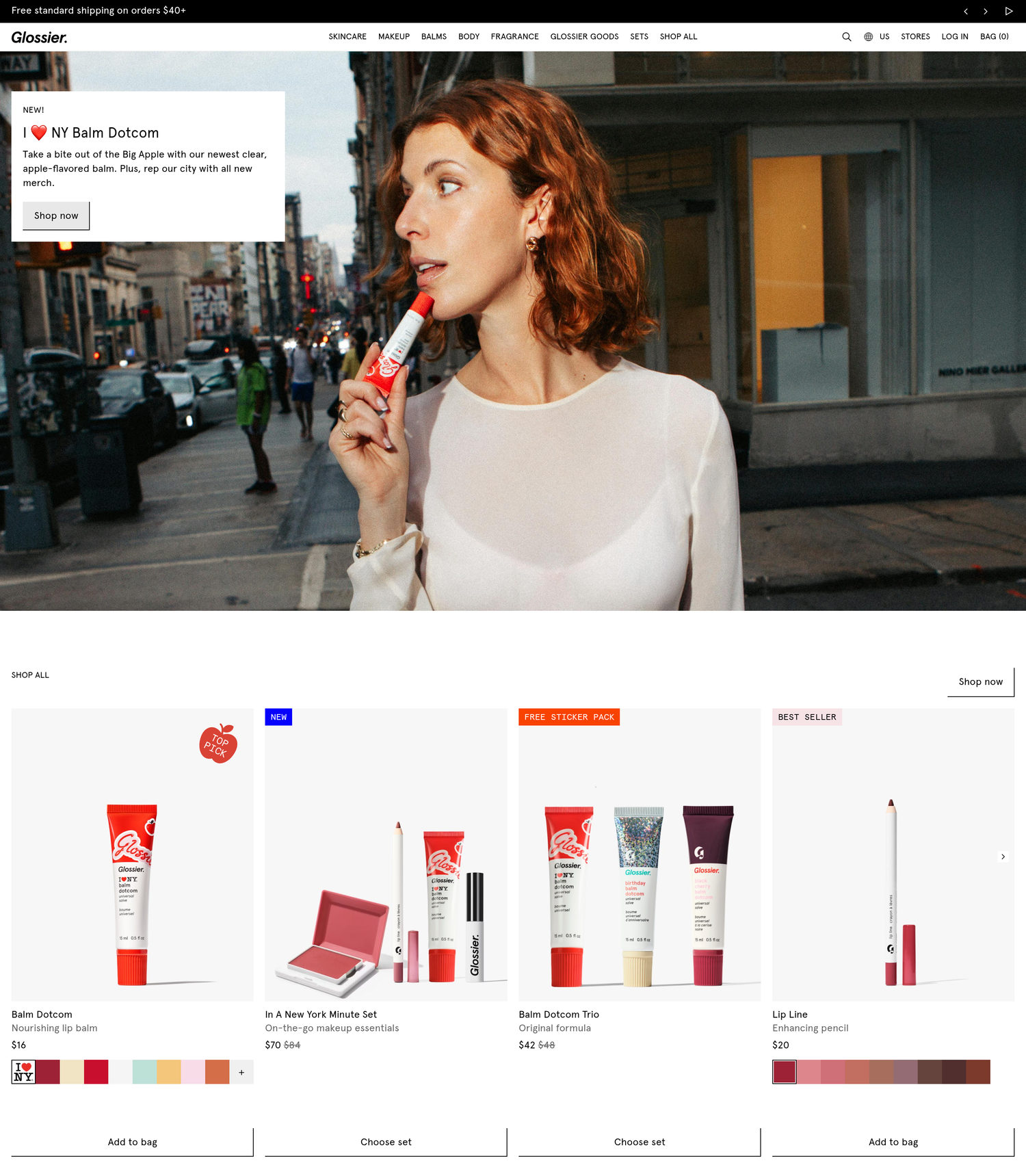
Public reporting · valuation (estimated interim)Their storefront, captured live.
Notice who’s in the hero: not a model, a real person on a real street. The whole aesthetic says “you,” not “aspiration.”
The plays
Seven moves behind Glossier.
Move 01 of 07
Build the audience before the product
Into The Gloss ran for four years and reached 2–3 million monthly readers before Glossier sold a thing. That audience was a captive market and a free R&D panel on launch day. Starting with demand instead of chasing it is the single biggest advantage a brand can have.
Move 02 of 07
Turn customers into co-creators
Glossier treated comments and DMs as product briefs — the Milky Jelly Cleanser came straight out of a blog thread asking readers about their ideal cleanser. When customers help design the product, they’re pre-sold on it.
Move 03 of 07
Make the customer the campaign
Instead of polished models, Glossier featured real customers — regramming faces, hands, and bathroom shelves. Peer proof from someone who looks like you converts far harder than an airbrushed ad.
Move 04 of 07
Lead with a hero gateway product
Balm Dotcom and Boy Brow are cheap, universal, giftable — the low-risk first purchase that pulls someone into the whole routine. A great front-door product does more acquisition than any funnel.
Move 05 of 07
Design a brand people post for you
The millennial-pink pouch, the stickers, the minimalist type — Glossier engineered an aesthetic people wanted to photograph. Every unboxing became free media.
Move 06 of 07
Stand for a point of view
“Skin first, makeup second” wasn’t a tagline — it was a worldview a generation belonged to. A POV turns customers into believers who defend you.
Move 07 of 07
Eventually, go where the faithful aren’t
Glossier’s community-and-DTC-only model plateaued; the Sephora wholesale move finally reached millions Instagram never could. Community starts you; distribution scales you.
The trade-offs
Being loved is not the same as being distributed — or profitable.
Be clear-eyed. Community is the best possible start, but it isn’t a business model by itself. Glossier’s DTC-and-community-only approach stalled: in 2022 the brand laid off staff, its ambitious social-commerce pivot failed, and Emily Weiss stepped down as CEO. Growth only re-accelerated once Glossier did the un-cool thing and went wholesale through Sephora. The lesson for anyone copying the audience-first playbook: an owned community lowers your acquisition cost and de-risks your launch, but you still need product velocity, fresh customer acquisition, real margins, and distribution beyond the faithful. Adore your community — just don’t mistake their love for a moat.
The Glossier playbook on one screen.
- Audience first. Build the community before the product; launch to fans.
- Co-create. Let customers design what you make.
- Customer = campaign. Real people out-convert models.
- Hero gateway. One cheap, beloved product recruits everyone.
- Postable brand. Design that people share is free media.
- Have a POV. “Skin first” is a worldview to belong to.
- Then distribute. Community starts you; retail scales you.
Keep reading.
All teardowns
Ready when you are
Put these playbooks to work.
Bring us the brand you’re building. We’ll show you what the launch, the offer, and the field could look like in Fluid.
Book a demo