
Brand teardownsFood & beverage
A free sip.
A billion-dollar
habit.
Liquid I.V. built the Nº 1 powdered hydration brand in America — now over $1 billion inside Unilever — by putting a single stick in your hand before it ever asked for the sale. Sampling is the whole funnel. Here’s the teardown.
Start reading
- Revenue
- $1B+
- US powdered hydration
- Nº 1
- Founded
- 2012
- Unilever acquired
- 2020
- Per stick, ~
- $1
- Since acquisition
- 4×
The idea
You don’t argue someone into believing a drink works — you let them feel it. That’s the entire Liquid I.V. playbook.
Before it was a billion-dollar brand, it was a team handing out free sticks at races, festivals, gyms and offices, betting that one taste of “I actually feel more hydrated” beats any ad ever written. The product is the pitch, and the sample is how you get it past someone’s skepticism. Here’s how a giveaway became a growth engine.
By the end you’ll have the seven plays behind turning free samples into the Nº 1 hydration brand in America — each with a “steal this” you can run tomorrow.
They didn’t launch with an ad. They launched with a taste.
Liquid I.V. started in 2012 with a simple promise — one stick in 16oz of water hydrates you faster than water alone, thanks to its electrolyte ratio (they call it Cellular Transport Technology). But the real innovation wasn’t the powder. It was the go-to-market: get the product into as many mouths as possible, for free, and let the feeling do the selling.
Sampling and experiential activation, in the company’s own words, have been core to the strategy from day one — festivals, races, gyms, offices, retail demos. By 2020 the brand was doing $200M+ and Unilever bought it; since then it has quadrupled to over $1 billion.
“A claim can be doubted. A feeling can’t. Put it in their hand first.”The Liquid I.V. operating principle
The receipts — a sample, compounded
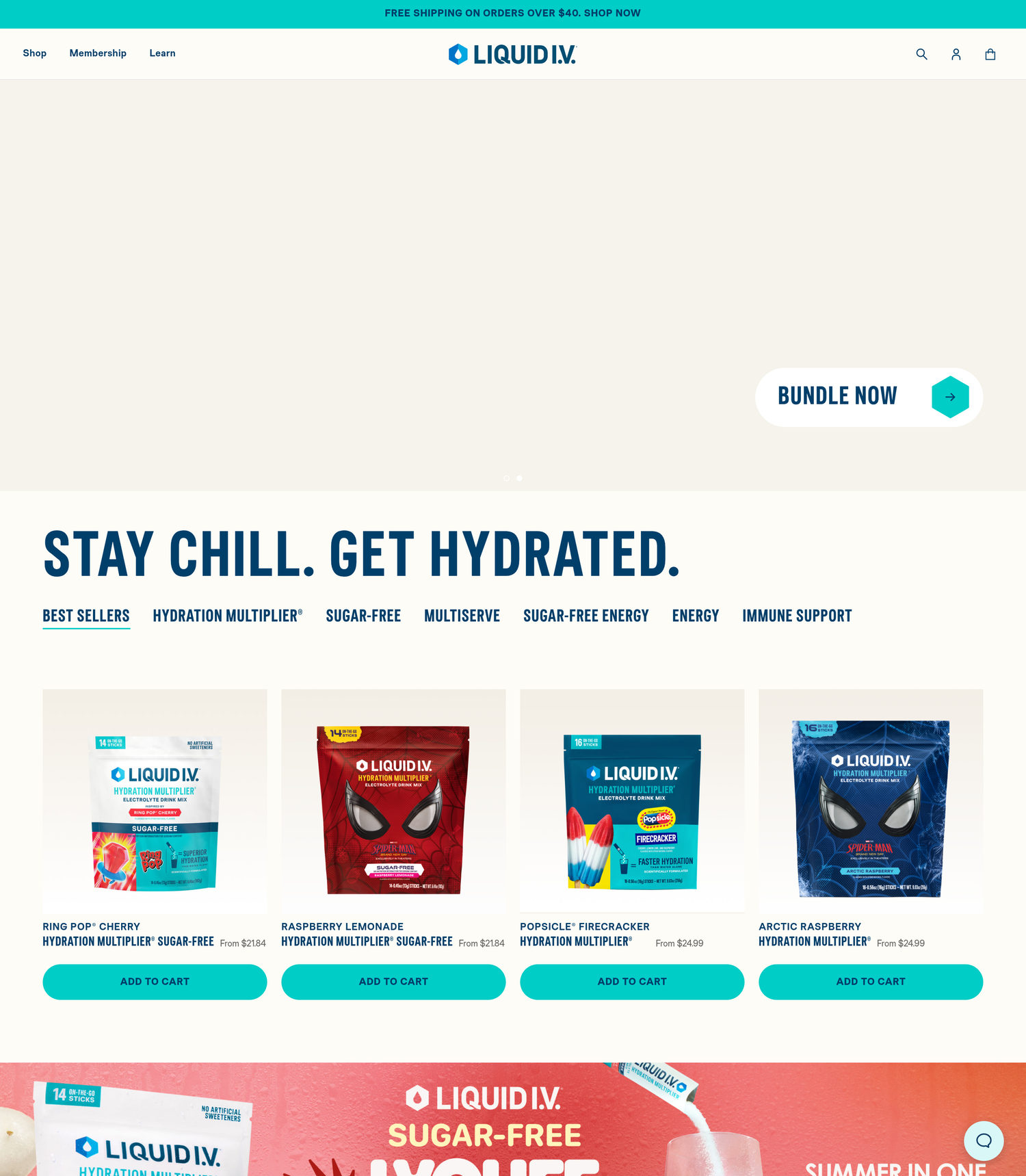
Public reporting · estimated annual revenueTheir storefront, captured live.
Notice how the whole site is built to lower the risk of the first purchase — free-shipping thresholds, bundles, and a flavor for every craving.
The plays
Seven moves behind Liquid I.V.
Move 01 of 07
Let them feel it — sampling is the funnel
The hardest part of selling a functional product is belief. Liquid I.V. skips the argument by handing you a free stick at a race, a festival, or a store demo. One sip of “I actually feel more hydrated” does what no ad can — and the cost of a sample is trivial next to the lifetime value of a convert.

Move 02 of 07
Sell one hero format, endless flavors
Liquid I.V. is essentially one thing — the Hydration Multiplier stick — in a rotating wall of flavors and collabs. The single format keeps the promise simple; the flavors create constant novelty and trial without fragmenting the brand.
Move 03 of 07
Name the moment you solve
The brand anchors itself to a specific occasion — the 4pm slump it calls “I.V. O’Clock,” the post-workout, the hangover, the flight. Attaching the product to a moment people already recognize makes it a habit, not an impulse.
Move 04 of 07
Wrap the feeling in a little science
“Cellular Transport Technology,” the electrolyte ratio, “hydrates faster than water alone” — a light layer of mechanism gives the felt benefit a credible why. Enough science to justify the feeling, not so much that it gets complicated.
Move 05 of 07
Turn the free trial into a subscription
The sample creates the believer; the site converts them with bundles, membership, and subscribe-and-save. Because hydration is a daily habit, the reorder is the real business — the giveaway just buys the first one.
Move 06 of 07
Ride a cause and a collab
Liquid I.V. pairs a donation mission (servings donated) with pop-culture collabs — Spider-Man, Ring Pop, Popsicle. The cause earns goodwill and the collabs earn attention — both create fresh reasons to sample and share.
Move 07 of 07
Go omnichannel once demand is proven
Sampling proved the demand; then Liquid I.V. blanketed Costco, Amazon, Target and grocery — and, under Unilever, TV, OOH and beyond. DTC and demos built the belief; mass retail scaled it to a billion dollars.
The trade-offs
When sampling works, the giants copy it — and out-sample you.
Be clear-eyed. First, it’s a commoditizing category: electrolyte powders are now everywhere (LMNT, Prime, store brands), and a stick of salt and sugar is easy to knock off — so the moat is brand and distribution, not formula. Second, once you prove sampling sells hydration, better-funded players (including the very conglomerate that bought you) can out-sample and out-distribute a challenger overnight. Sampling is a brilliant way to start; it is not, by itself, a durable advantage. And “hydrates faster than water” style claims draw scrutiny as the category matures. Win the trial, but build the brand and the shelf before someone with a bigger sampling budget shows up.
The Liquid I.V. playbook on one screen.
- Sampling is the funnel. Let people feel the benefit for free before you ask for the sale.
- One hero format, endless flavors. Simple promise, constant novelty.
- Name the moment. Own an occasion — the 4pm slump, the flight, the workout.
- A little science. Give the felt benefit a credible, named why.
- Trial → subscription. The sample buys the first order; retention is the business.
- Cause + collab. Manufacture goodwill and attention a commodity can’t.
- Prove it, then go everywhere. DTC to prove demand, retail to scale it.
Keep reading.
All teardowns
Ready when you are
Put these playbooks to work.
Bring us the brand you’re building. We’ll show you what the launch, the offer, and the field could look like in Fluid.
Book a demo